Africa in the World · Book 1
Routes of Gold, Cities of Stone
How African Kingdoms Connected People, Ideas, and Power
Written by Jossy Ibe
Published by DALFAST, s.r.o.
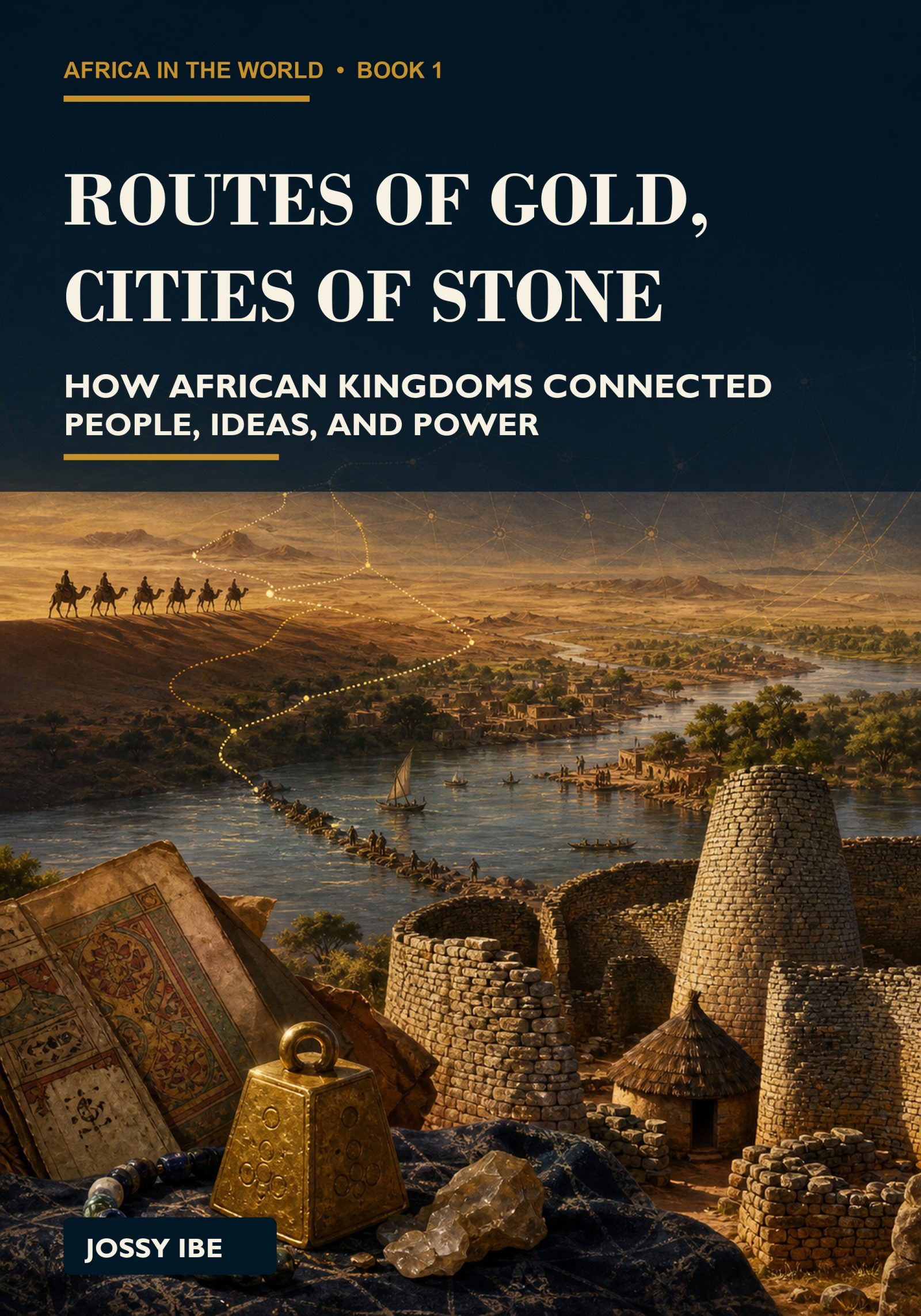
Africa in the World · Book 1
How African Kingdoms Connected People, Ideas, and Power
Written by Jossy Ibe
Published by DALFAST, s.r.o.
Copyright © 2026 Jossy Ibe
All rights reserved.
Written by Jossy Ibe
Published by DALFAST, s.r.o.
Na pasekách 20
831 06 Bratislava
Slovak Republic
www.dalfast.com
First edition, 2026
Series Note
This series explores African histories as locally grounded and widely connected. It follows people, places, objects, ideas, environments, and evidence across changing scales without turning a diverse continent into one story.
Connections do not mean that every place belonged to one network or experienced change in the same way. Routes shifted. Political communities changed. Languages, beliefs, technologies, and materials moved through many hands. Some relationships were cooperative; others involved unequal power, conflict, coercion, or loss.
Begin with African places and choices. Trace claims to evidence. Compare without ranking. Name uncertainty. Keep communities and regions distinct.
Reader Guide
You do not need to memorize every name, date, or route. Use the page signals to locate a case, understand its time, identify the evidence, and decide how strong a claim can be.
PLACE ANCHOR | Locates the specific region, city, river, coast, or route used by the case. |
|---|---|
DATE RANGE | Bounds the claim in time. Overlapping ranges do not create one continental sequence. |
EVIDENCE TYPE | Names what you are reading: object, building, account, map, inscription, oral history, timeline, or scientific result. |
OBSERVED | A detail directly documented in the selected evidence or its recorded context. |
INFERRED | A reasoned interpretation built from evidence and context, not a direct observation. |
DISPUTED | Qualified interpretations differ; the disagreement and evidence should be explained fairly. |
UNKNOWN | The evidence does not currently establish an answer. |
PRONUNCIATION | A pronunciation aid tied to a specific language or community source, with relevant variation kept visible. |
EVIDENCE LAB Observe first. Ask a bounded question. Build a claim from relevant evidence. Explain the link. State a limit. Test the claim with another source. Revise when the evidence requires it. |
|---|
Continue reading Routes of Gold, Cities of Stone with the full edition.
Get the full book →